Ritual sacrifice
Hallowe'en PartyRitual sacrifice gives Michael Garfield’s planned murder of Miranda Butler its form and false meaning: he turns a local ancient site, a golden goblet, and Miranda’s grief over Joyce Reynolds into a staged offering. The novel contrasts that lethal performance with the ordered, playful ceremonies of a Hallowe’en party, showing how familiar ritual patterns can be appropriated to make violence seem inevitable or sacred.
Ritual, Place, and Ceremony
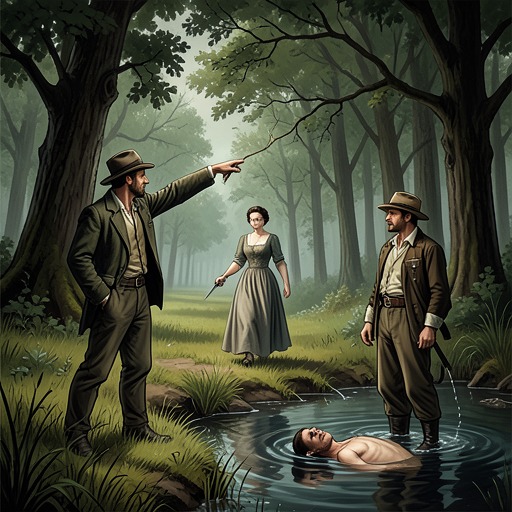
At Kilterbury Ring, Miranda calls the place beautiful, although its remains are not especially famous: the stones have been dismantled over many centuries, and only a few megalithic stones still stand upright. Their survival connects the present landscape to what the conversation describes as long-past ritual worship. When Miranda asks why the stones were there, her companion answers by naming ritual worship and ritual sacrifice, then asks whether she understands sacrifice. The exchange gives the setting an apparent religious vocabulary before revealing how that vocabulary will be used against her.
The novel also places ritualized activity in a very different register at Rowena Drake’s Hallowe’en party. The evening follows a programme: a broomstick competition, cutting the flour cake, bobbing for apples, dancing with partners changed whenever the lights go out, mirrors for the girls, supper, Snapdragon, and prize-giving. The party’s finale gathers everyone around flaming raisins on a green baize-covered table; the children rush to snatch them, shrieking when burned, until the flames die and the lights come up. These customs are organized, shared, and playful. Their prescribed sequence and symbolic props offer a pointed contrast to the private ceremony at Kilterbury Ring, where ritual is not a communal celebration but a means of directing one vulnerable person toward death.
Miranda’s Guilt and the Designed Offering
Miranda’s readiness to accept the role of victim grows from her belief that she caused Joyce’s death. At the Ring, she says she had wondered whether she ought to die because her own action had killed someone else. Her reasoning transforms remorse into a sentence: if Joyce would still be alive had Miranda not told her something, then Miranda imagines that her own death might be right. Garfield’s plan exploits this self-blame rather than simply confronting her with physical danger. As Hercule Poirot later explains, he had indoctrinated Miranda with the idea of sacrifice, making her susceptible to the notion that a ritual killing could be deserved.
Garfield gives that idea a carefully staged setting and sequence. Miranda is to tell him if she is leaving Woodleigh Common and to meet him at the inn where Hercule Poirot and Ariadne Oliver had lunched. He intends her to be found at Kilterbury Ring beside the sign of the double axe, with a golden goblet at her side. At the site, he draws attention to the worn double-axe symbol and asks Miranda to place her hand on it. He then proposes a drink to the past, the future, and beauty. A golden cup is put into her hand, and he pours a golden liquid from a flask. The objects and gestures give the encounter the appearance of a rite while advancing a murder plot.
The danger becomes immediate when Miranda is attacked at the Ring. A knife is knocked from the hand that is rising, and Nicholas Ransom seizes Miranda and drags her away from the struggle. Once rescued, she describes herself as having been meant for sacrifice and repeats her belief that Joyce died because of her. Nicholas rejects her framing as nonsense about ritual killings and tells her that the missing au pair girl has been found dead in a well. Miranda’s rescue therefore breaks the imposed ceremony, but her response shows how thoroughly Garfield’s script had joined her guilt to the prospect of her own death.
Garfield’s Motive and the Reversal of Sacrifice
Hercule Poirot’s explanation identifies the intended victim and the purpose behind the staging. Garfield was prepared to sacrifice Miranda to save himself. He had made the planned death into a ritual and encouraged Miranda to accept its logic; the Ring, the double axe, and the goblet were parts of an arrangement in which she was to appear as a sacrificial victim. The design made an attempted murder look, in advance, like an enactment Miranda herself had accepted.
The ending reverses that design. Garfield is dead by the megalithic stone marked with the double axe, still holding the golden goblet he had seized and drained. The cup that was meant to accompany Miranda’s body instead remains with the man who arranged the killing, as retribution arrives and Miranda is saved. The reversal strips the staged sacrifice of its promised control: Garfield cannot dictate who dies or preserve himself through the death he planned for another.
Myth, Beauty, and the Meaning of Sacrifice
The final interpretation links Garfield’s scheme to beauty as well as to religious and mythic imagery. Poirot describes Garfield as a man who loved beauty and was willing to sacrifice everything to the beauty he created with his brain, imagination, and hands. He thinks Garfield had, in his own way, loved Miranda, yet was still ready to sacrifice her for his own safety. The contradiction matters: affection does not prevent Garfield from treating Miranda as an expendable element in an aesthetic design.
The name Iphigenia makes that design legible through a myth of a father sacrificing his daughter. Poirot compares Agamemnon’s sacrifice of Iphigenia to Garfield’s willingness to sacrifice Miranda so that he could have a new Garden of Eden. Judith Butler wonders whether Garfield would ever have felt regret, but Poirot does not answer. The novel leaves that question unresolved while completing the concrete reversal: Garfield’s beautiful, ritualized plan ends not in Miranda’s death, but in his own, with the goblet and the marked stone bearing witness to the failed offering. Ritual sacrifice thus becomes more than an eerie reference to the ancient past; it is the form Garfield uses to disguise self-preservation as destiny, and the means by which the story exposes the violence beneath that disguise.